Trough Screw Conveyors for Powder Transport
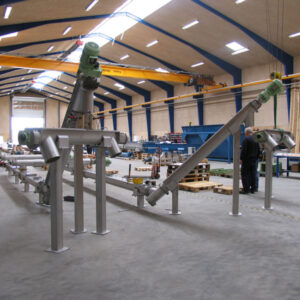
Trough screw conveyors for powder transport for use on an offshore installation, where they are applied for mud mixing.
Why Are Trough Screw Conveyors Used for Transport of Granulate in This Application?
- The customer required that these trough screw conveyors can be opened, allowing access to the screw rotor
- The trough screw conveyors require cleaning at specific service intervals
- It must be possible to remove the screw rotors from the trough screw conveyors without pulling them completely out from one end due to space constraints
See a similar solution for powder transport here
What Is Special About Trough Screw Conveyors for Material Transport?
- Unlike a tubular screw conveyor, a trough screw conveyor is manufactured from steel plates. The plates are rolled or bent to form a housing around the screw rotor
- Trough screw conveyors typically have a U-shaped contour. Variations with other contours are possible depending on the material being transported
- The trough screw conveyors can be equipped with covers on top. The covers can be bolted or hinged, allowing the entire screw to be opened for service or cleaning
- Compared to tubular screw conveyors, there are more options for designing different cover solutions for trough screw conveyors and implementing measures for cleaning and inspection
- Compared to tubular screw conveyors, there are more possibilities regarding the design of trough screw conveyors
What Is Special About These Trough Screw Conveyors?
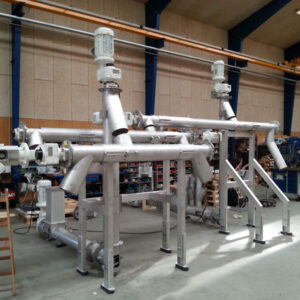
- Three identical systems have been manufactured, where it is possible in the trough screw conveyors to run two types of powder to two different outlets
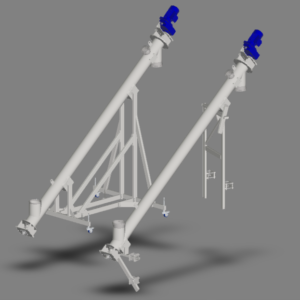
- The trough screw conveyors consist of:
- A dosing screw conveyor
- A lifting screw conveyor
- A distribution screw conveyor to the individual outlets
- Support frames have been manufactured for these trough screw conveyors for powder transport, enabling the installation phase to be carried out as quickly and efficiently as possible
Where Can BEMA Help Make Installation of Trough Screw Conveyors Fast and Efficient?
- During the design phase, BEMA can design supports for trough screw conveyors. The supports are tailored precisely to the installation location
- Trough screw conveyors can be delivered complete with supports and legs. This minimizes installation time
- BEMA understands that the installation phase constitutes a significant part of the total cost for trough screw conveyors – we can help reduce these costs by considering this already in the design phase
- BEMA can participate in installation work. We can provide a supervisor or actively take part in the installation process
FAQ – Trough Screw Conveyors for Powder Transport
What is the purpose of trough screw conveyors for powder transport?
Trough screw conveyors are used for efficient handling of powder and granulate, especially in installations where equipment must be opened for cleaning and service. They are well suited for applications such as offshore mud mixing, where operational reliability and access to the screw rotor are essential.
What makes trough screw conveyors flexible in design?
Unlike tubular screw conveyors, trough screw conveyors are manufactured from rolled or bent steel plates, typically with a U-shaped contour. They can be equipped with bolted or hinged covers, providing more options for cleaning, inspection, and adaptation to different materials and process requirements.
How do these trough screw conveyors handle multiple powder types?
The described systems consist of a dosing screw, a lifting screw, and a distribution screw, making it possible to transport two types of powder to two different outlets. This setup provides precise control of material flow and high flexibility in complex process lines.
How does BEMA optimize installation and assembly?
BEMA designs supports that fit precisely at the installation site and delivers trough screw conveyors complete with legs and frames. This significantly reduces installation time and costs, and the company can also provide a supervisor or installation personnel for fast and efficient commissioning.
- Diameter of screw rotors for trough screw conveyors: Ø180
- Length of trough screw conveyors for powder transport – 10277: 1,500 – 4,500 mm
- Housing material: Stainless steel 1.4401 / AISI-316
- Screw rotor material: Stainless steel 1.4401 / AISI-316
- Execution: All welds are 100% completed
- Surface treatment: Acid pickled after manufacturing
- Surface treatment of gear units and bearings for trough screw conveyors: Painted in customer-defined RAL color in accordance with offshore coating specifications
| House | Trough |
|---|---|
| Industry | Chemical and process industry |
| Transported material | Biomass, Powder |
| Applied steel in product | Stainless steel |
| Product type | Screw conveyor |
| Surface treatment | Stainless steel – acid pickled |
Related solutions
-

Powder screw conveyors for fishmeal
30023Read more -
Dosing screw conveyor powder distribution system
8994Read more -
Tubular inclined ATEX screw conveyors
35470Read more -
Tubular Screw Conveyor for Powder Transport
18403Read more -

Horizontal screw conveyor for potato starch
18830Read more -

Pipe screw conveyors with ATEX approval
36828Read more -

Screw conveyor for abrasive powder
34778Read more